
This page focuses on the neuropsychiatric manifestations associated with lesions of the inferior parietal lobule (IPL).
Cognitive, behavioural, and psychiatric effects of lesions may also arise through mechanisms other than network disruption; the potential contribution of these mechanisms can be considered using the Neuropsychiatric Effects of CNS Structural Abnormalities (NECSA) classification.
Inferior parietal lobule (IPL)
Page most recently updated 7 September 2026
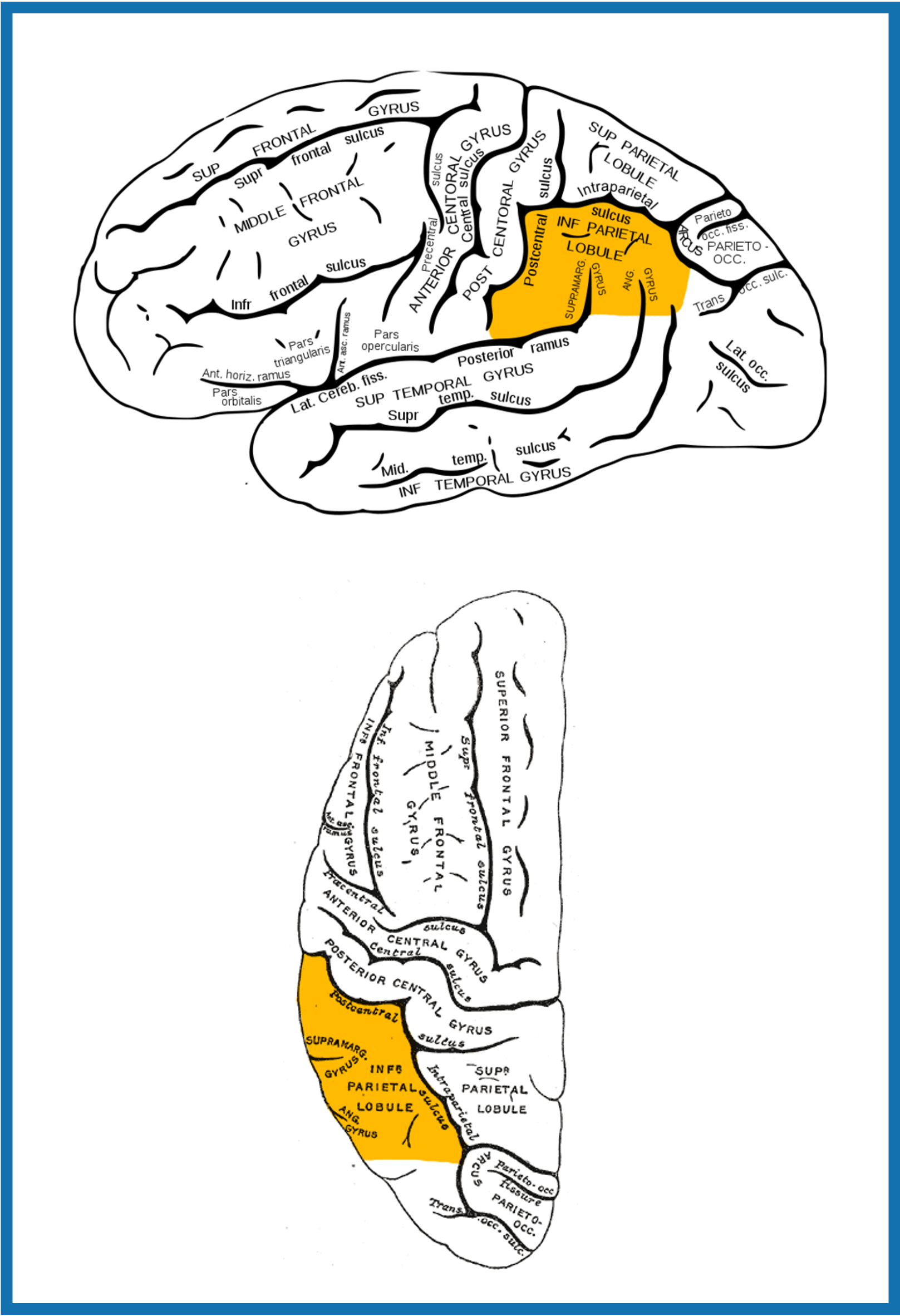
Inferior parietal lobule
Diagrams of the cerebrum from multiple aspects, with the inferior parietal lobule marked in yellow.
Image credit: Adapted from Gray's Anatomy, via Wikimedia Commons. Public domain.
● Lesion manifestations
▪ Depending on hemisphere:
◦ Right IPL
Hemispatial neglect
Impaired awareness of deficits
Spatial disorientation
Constructional impairment
◦ Left IPL
Apraxia
Language-symbolic deficits
Gerstmann syndrome components
Acalculia
Agraphia
Finger agnosia
Left–right disorientation
● Clinical pearls
▪ IPL is one of the most multimodal regions of cortex.
▪ It should be thought of as an integration hub rather than a single-function area.
▪ Composed of:
◦ Angular gyrus (predominantly Brodmann area 39)
◦ Supramarginal gyrus (predominantly Brodmann area 40)
▪ Lesions frequently produce syndromes that appear psychiatric because they affect self-awareness, behaviour, and social cognition.
▪ Dominant angular gyrus lesions are classically associated with Gerstmann syndrome. The “classic tetrad” of Gerstmann syndrome is a useful teaching construct, but patients with left angular gyrus lesions often present with partial Gerstmann syndromes, usually dominated by language, calculation, or symbolic-processing deficits rather than all four features together.
Clinical reminder: consider NECSA mechanisms
(Neuropsychiatric Effects of CNS Structural Abnormalities)
When a structural lesion is identified in a patient presenting with neuropsychiatric symptoms, consider which NECSA mechanisms may explain these symptoms:
● Network disruption
Disruption of functional networks due to the presence of the lesion
● Electrical disturbance
Ictal, preictal, postictal, or interictal effects due to epileptic activity associated with the lesion (particularly if involving or adjacent to cortex)
● Chemical (endocrine) effects
Hormone excess or deficiency caused by the lesion (particularly if involving the pituitary gland or hypothalamus)
● Side effects of treatment
Effects of medications, surgery, radiotherapy, or other interventions
● Alternative explanations
The lesion may be incidental, or symptoms may arise from another cause (e.g., psychological response to illness or a comorbid psychiatric condition)
Selected references and further reading — Lesional lens
Rohlfing T, Zahr NM, Sullivan EV, Pfefferbaum A. The SRI24 multichannel atlas of normal adult human brain structure. Hum Brain Mapp. 2010;31(5):798–819.
Clark DL, Boutros NN, Mendez MF. The brain and behavior: an introduction to behavioral neuroanatomy. 4th ed. Cambridge: Cambridge University Press; 2018.
Brazis PW, Masdeu JC, Biller J. Localization in clinical neurology. 7th ed. Philadelphia: Wolters Kluwer/Lippincott Williams & Wilkins; 2016.
Blumenfeld H. Neuroanatomy through clinical cases. 3rd ed. New York: Oxford University Press; 2021.
Hassan I. The neuropsychiatric effects of CNS structural abnormalities (NECSA) classification: an aid to differential diagnosis. Aust N Z J Psychiatry. 2015;49(10):943.
Arciniegas DB, Yudofsky SC, Hales RE, editors. The American Psychiatric Association Publishing textbook of neuropsychiatry and clinical neurosciences. 6th ed. Washington (DC): American Psychiatric Association Publishing; 2018.
Agrawal N, Faruqui R, Bodani M, editors. Oxford textbook of neuropsychiatry. Oxford: Oxford University Press; 2020.