
This page focuses on the neuropsychiatric manifestations associated with lesions of the medial prefrontal cortex (mPFC).
Cognitive, behavioural, and psychiatric effects of lesions may also arise through mechanisms other than network disruption; the potential contribution of these mechanisms can be considered using the Neuropsychiatric Effects of CNS Structural Abnormalities (NECSA) classification.
Medial prefrontal cortex (mPFC)
Page most recently updated 7 September 2026
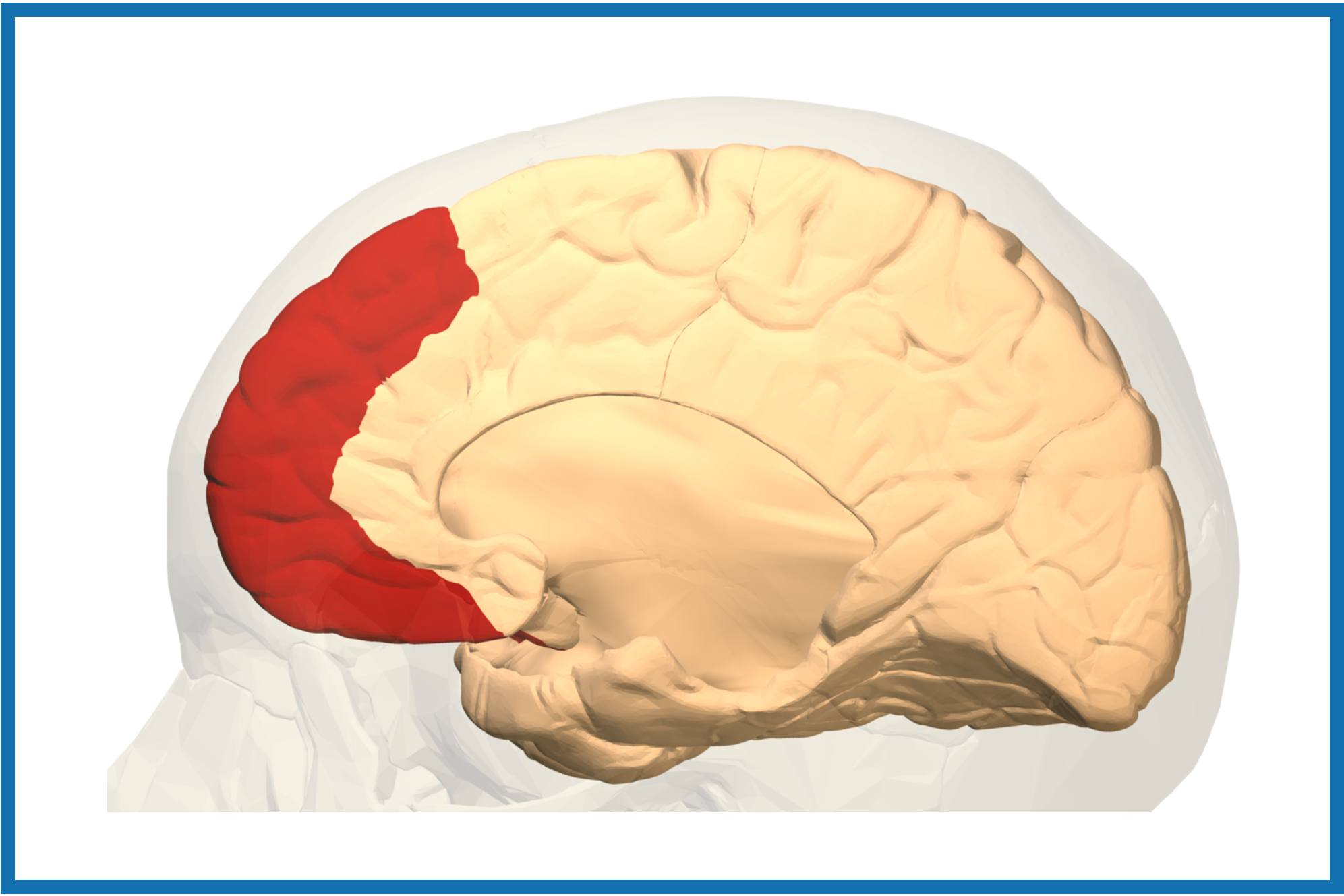
Medial prefrontal cortex (mPFC)
The mPFC encompasses a broad region of the medial prefrontal surface, including dorsomedial and ventromedial territories. Its boundaries, and those between mPFC, dmPFC and vmPFC, are not uniformly defined and vary between anatomical, cytoarchitectonic and functional parcellation schemes.
Image credit: Database Center for Life Science (DBCLS), BodyParts3D/Anatomography. CC BY-SA 2.1 Japan, via Wikimedia Commons. Image cropped from the original.
● Lesion manifestations
▪ Apathy
▪ Reduced initiation
▪ Impaired self-awareness
▪ Reduced spontaneous behaviour
▪ Social cognition deficits
● Clinical pearls
▪ mPFC dysfunction often presents as reduced internal drive rather than overt cognitive impairment.
▪ Patients may describe themselves as "not caring" or "unable to get started."
Clinical reminder: consider NECSA mechanisms
(Neuropsychiatric Effects of CNS Structural Abnormalities)
When a structural lesion is identified in a patient presenting with neuropsychiatric symptoms, consider which NECSA mechanisms may explain these symptoms:
● Network disruption
Disruption of functional networks due to the presence of the lesion
● Electrical disturbance
Ictal, preictal, postictal, or interictal effects due to epileptic activity associated with the lesion (particularly if involving or adjacent to cortex)
● Chemical (endocrine) effects
Hormone excess or deficiency caused by the lesion (particularly if involving the pituitary gland or hypothalamus)
● Side effects of treatment
Effects of medications, surgery, radiotherapy, or other interventions
● Alternative explanations
The lesion may be incidental, or symptoms may arise from another cause (e.g., psychological response to illness or a comorbid psychiatric condition)
Selected references and further reading — Lesional lens
Rohlfing T, Zahr NM, Sullivan EV, Pfefferbaum A. The SRI24 multichannel atlas of normal adult human brain structure. Hum Brain Mapp. 2010;31(5):798–819.
Clark DL, Boutros NN, Mendez MF. The brain and behavior: an introduction to behavioral neuroanatomy. 4th ed. Cambridge: Cambridge University Press; 2018.
Brazis PW, Masdeu JC, Biller J. Localization in clinical neurology. 7th ed. Philadelphia: Wolters Kluwer/Lippincott Williams & Wilkins; 2016.
Blumenfeld H. Neuroanatomy through clinical cases. 3rd ed. New York: Oxford University Press; 2021.
Hassan I. The neuropsychiatric effects of CNS structural abnormalities (NECSA) classification: an aid to differential diagnosis. Aust N Z J Psychiatry. 2015;49(10):943.
Arciniegas DB, Yudofsky SC, Hales RE, editors. The American Psychiatric Association Publishing textbook of neuropsychiatry and clinical neurosciences. 6th ed. Washington (DC): American Psychiatric Association Publishing; 2018.
Agrawal N, Faruqui R, Bodani M, editors. Oxford textbook of neuropsychiatry. Oxford: Oxford University Press; 2020.