
This page focuses on the neuropsychiatric manifestations associated with lesions of the optic radiations (geniculocalcarine tract).
Cognitive, behavioural, and psychiatric effects of lesions may also arise through mechanisms other than network disruption; the potential contribution of these mechanisms can be considered using the Neuropsychiatric Effects of CNS Structural Abnormalities (NECSA) classification.
Optic radiations (geniculocalcarine tract)
Page most recently updated 7 September 2026
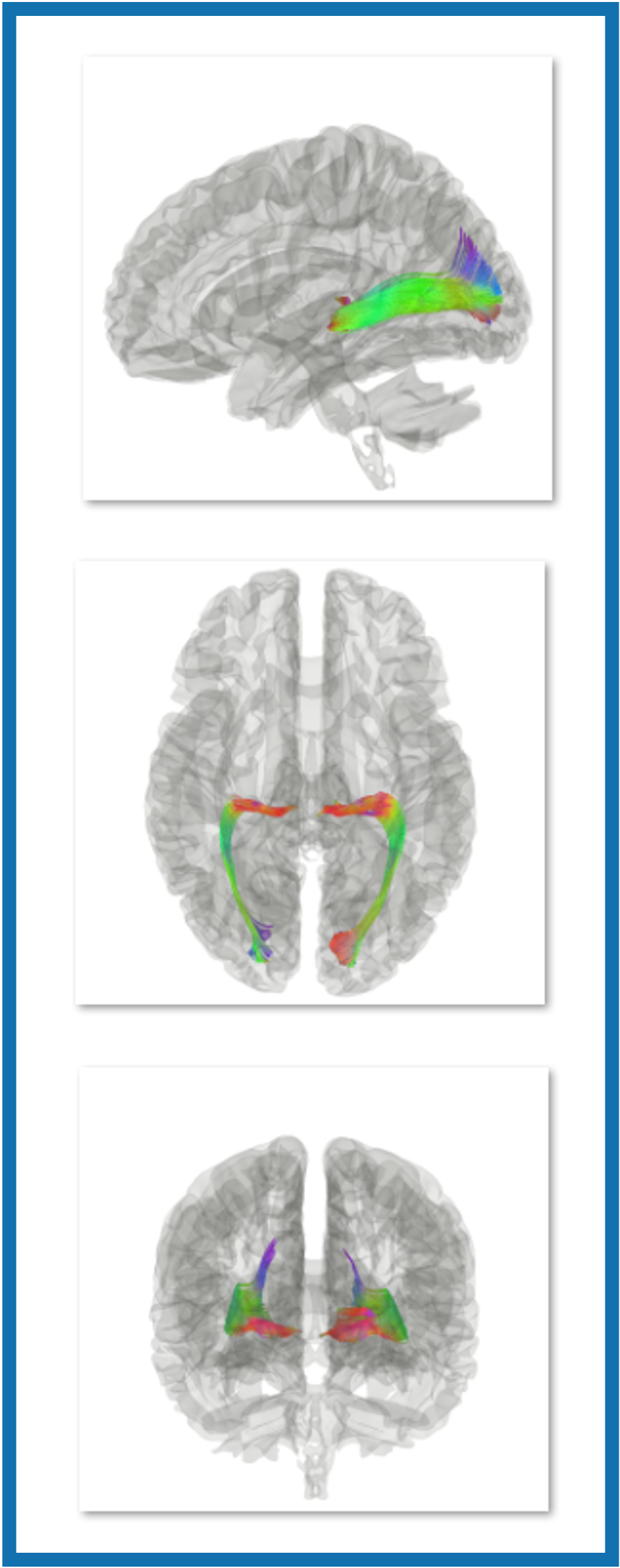
Optic radiations
The tract is shown in sagittal, axial, and coronal views.
Image credit: Adapted from Yeh et al. (2018), Population-averaged atlas of the macroscale human structural connectome and its network topology. CC BY-SA 4.0, via Wikimedia Commons.
● Lesion manifestations
▪ Temporal component (Meyer’s loop) injury:
◦ Contralateral superior quadrantanopia (“pie in the sky”)
▪ Parietal component (Baum’s loop) injury:
◦ Contralateral inferior quadrantanopia (“pie on the floor”)
▪ Complete unilateral optic radiation injury:
◦ Contralateral homonymous hemianopia
▪ Bilateral posterior visual pathway injury:
◦ Cortical blindness
● Clinical pearls
▪ Optic radiations carry visual information from the lateral geniculate nucleus to the primary visual cortex, with different fibres representing different parts of the visual field.
▪ The temporal lobe contains Meyer’s loop, which carries inferior retinal fibres representing the superior visual field; the parietal optic radiations (Baum’s loop) carry fibres representing the inferior visual field.
▪ Loss of visual input can occasionally produce visual release phenomena (deafferentation hallucinations), particularly in the setting of visual pathway injury or sensory deprivation. Earlier visual pathway deafferentation (e.g., retina, optic nerve, optic tract, or optic radiations) is more likely to produce simple or elemental phenomena (e.g., flashes, colours, shapes), whereas involvement of higher-order visual association networks (e.g., occipital association cortex, posterior parietal cortex, and ventral occipitotemporal regions) is more likely to produce complex formed hallucinations (e.g., objects, scenes, people).
Clinical reminder: consider NECSA mechanisms
(Neuropsychiatric Effects of CNS Structural Abnormalities)
When a structural lesion is identified in a patient presenting with neuropsychiatric symptoms, consider which NECSA mechanisms may explain these symptoms:
● Network disruption
Disruption of functional networks due to the presence of the lesion
● Electrical disturbance
Ictal, preictal, postictal, or interictal effects due to epileptic activity associated with the lesion (particularly if involving or adjacent to cortex)
● Chemical (endocrine) effects
Hormone excess or deficiency caused by the lesion (particularly if involving the pituitary gland or hypothalamus)
● Side effects of treatment
Effects of medications, surgery, radiotherapy, or other interventions
● Alternative explanations
The lesion may be incidental, or symptoms may arise from another cause (e.g., psychological response to illness or a comorbid psychiatric condition)
Selected references and further reading — Lesional lens
Rohlfing T, Zahr NM, Sullivan EV, Pfefferbaum A. The SRI24 multichannel atlas of normal adult human brain structure. Hum Brain Mapp. 2010;31(5):798–819.
Clark DL, Boutros NN, Mendez MF. The brain and behavior: an introduction to behavioral neuroanatomy. 4th ed. Cambridge: Cambridge University Press; 2018.
Brazis PW, Masdeu JC, Biller J. Localization in clinical neurology. 7th ed. Philadelphia: Wolters Kluwer/Lippincott Williams & Wilkins; 2016.
Blumenfeld H. Neuroanatomy through clinical cases. 3rd ed. New York: Oxford University Press; 2021.
Hassan I. The neuropsychiatric effects of CNS structural abnormalities (NECSA) classification: an aid to differential diagnosis. Aust N Z J Psychiatry. 2015;49(10):943.
Arciniegas DB, Yudofsky SC, Hales RE, editors. The American Psychiatric Association Publishing textbook of neuropsychiatry and clinical neurosciences. 6th ed. Washington (DC): American Psychiatric Association Publishing; 2018.
Agrawal N, Faruqui R, Bodani M, editors. Oxford textbook of neuropsychiatry. Oxford: Oxford University Press; 2020.