
This page focuses on the neuropsychiatric manifestations associated with lesions of the uncinate fasciculus.
Cognitive, behavioural, and psychiatric effects of lesions may also arise through mechanisms other than network disruption; the potential contribution of these mechanisms can be considered using the Neuropsychiatric Effects of CNS Structural Abnormalities (NECSA) classification.
Uncinate fasciculus
Page most recently updated 7 September 2026
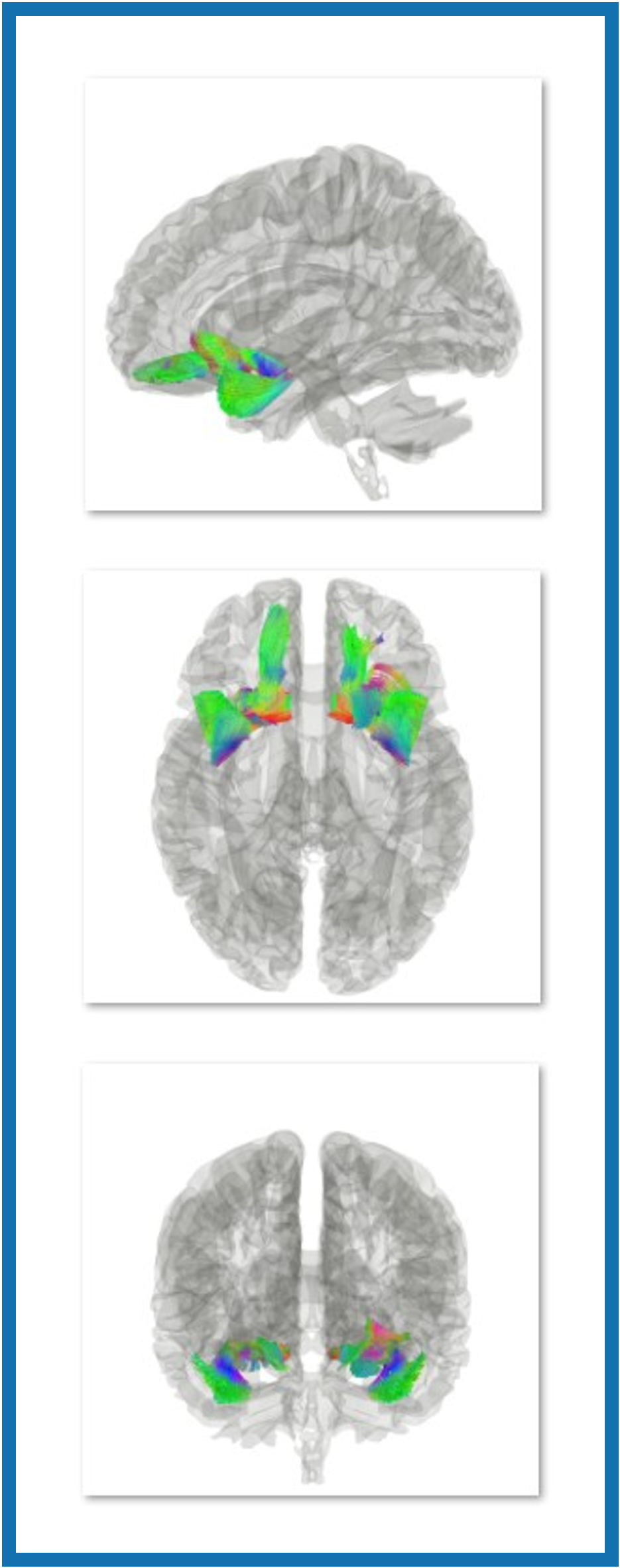
Uncinate fasciculus
The tract is shown in sagittal, axial, and coronal views.
Image credit: Adapted from Yeh et al. (2018), Population-averaged atlas of the macroscale human structural connectome and its network topology. CC BY-SA 4.0, via Wikimedia Commons.
● Lesion manifestations
▪ Social cognition impairment
▪ Reduced emotional recognition
▪ Impaired judgement
▪ Behavioural dysregulation
▪ Semantic retrieval difficulties
▪ May contribute to:
◦ Personality change
◦ Reduced empathy
● Clinical pearls
▪ Uncinate injury is a major mechanism linking frontal and temporal dysfunction.
▪ It provides a physical bridge between "cold cognition" (frontal cortex) and emotional memory (temporal limbic structures).
▪ Particularly important in:
◦ bvFTD
◦ TBI-related personality change
◦ limbic emotional processing disorders
Clinical reminder: consider NECSA mechanisms
(Neuropsychiatric Effects of CNS Structural Abnormalities)
When a structural lesion is identified in a patient presenting with neuropsychiatric symptoms, consider which NECSA mechanisms may explain these symptoms:
● Network disruption
Disruption of functional networks due to the presence of the lesion
● Electrical disturbance
Ictal, preictal, postictal, or interictal effects due to epileptic activity associated with the lesion (particularly if involving or adjacent to cortex)
● Chemical (endocrine) effects
Hormone excess or deficiency caused by the lesion (particularly if involving the pituitary gland or hypothalamus)
● Side effects of treatment
Effects of medications, surgery, radiotherapy, or other interventions
● Alternative explanations
The lesion may be incidental, or symptoms may arise from another cause (e.g., psychological response to illness or a comorbid psychiatric condition)
Selected references and further reading — Lesional lens
Rohlfing T, Zahr NM, Sullivan EV, Pfefferbaum A. The SRI24 multichannel atlas of normal adult human brain structure. Hum Brain Mapp. 2010;31(5):798–819.
Clark DL, Boutros NN, Mendez MF. The brain and behavior: an introduction to behavioral neuroanatomy. 4th ed. Cambridge: Cambridge University Press; 2018.
Brazis PW, Masdeu JC, Biller J. Localization in clinical neurology. 7th ed. Philadelphia: Wolters Kluwer/Lippincott Williams & Wilkins; 2016.
Blumenfeld H. Neuroanatomy through clinical cases. 3rd ed. New York: Oxford University Press; 2021.
Hassan I. The neuropsychiatric effects of CNS structural abnormalities (NECSA) classification: an aid to differential diagnosis. Aust N Z J Psychiatry. 2015;49(10):943.
Arciniegas DB, Yudofsky SC, Hales RE, editors. The American Psychiatric Association Publishing textbook of neuropsychiatry and clinical neurosciences. 6th ed. Washington (DC): American Psychiatric Association Publishing; 2018.
Agrawal N, Faruqui R, Bodani M, editors. Oxford textbook of neuropsychiatry. Oxford: Oxford University Press; 2020.