
Upslanted palpebral fissure
Page most recently updated 7 September 2026
This page focuses on upslanted palpebral fissure as a morphologic feature of conditions that may also be associated with psychiatric manifestations, such as psychosis, mania, autism spectrum disorder, ADHD, OCD, and self-injurious behaviours. The page begins with a clinical definition of upslanted palpebral fissure based on the standardized Elements of Morphology terminology, together with visual examples from the same source. This is followed by a list of conditions in which upslanted palpebral fissure has been described in association with psychiatric manifestations.
Of note, to optimize clinical utility, the list does not include conditions associated with intellectual disability in the absence of other psychiatric features.
Each condition listed below is linked to a dedicated page within this resource. These pages describe the psychiatric manifestations associated with each condition, as well as other morphologic and broader clinical features, allowing the differential diagnosis to be considered from multiple perspectives.
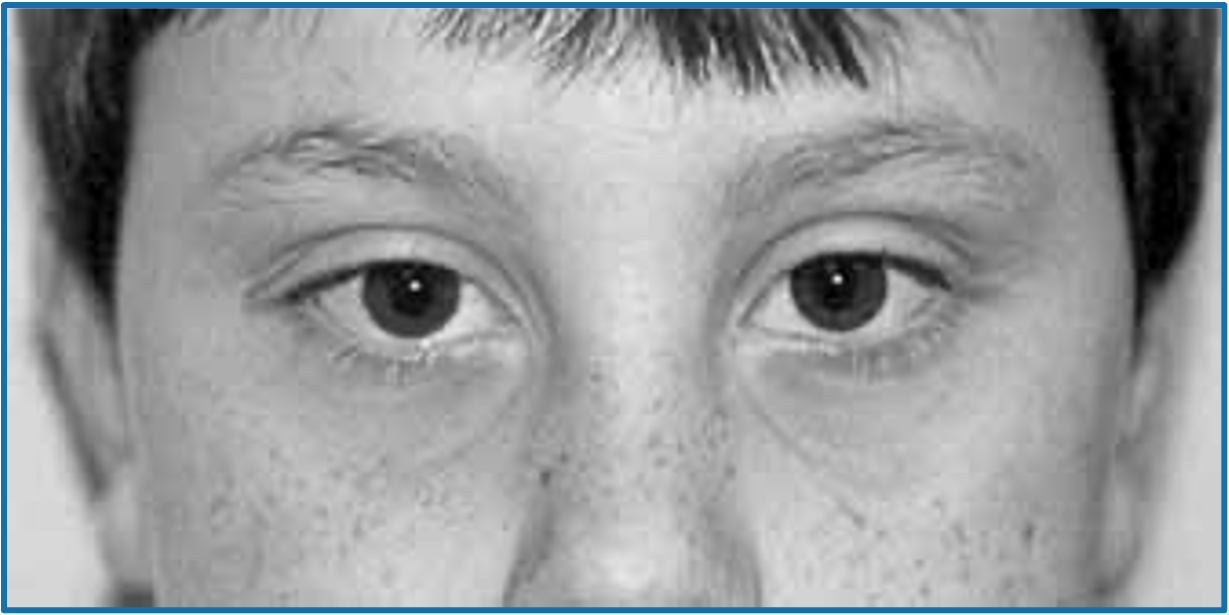
Upslanted palpebral fissures
Image credit: National Human Genome Research Institute (NHGRI), Elements of Morphology.
Definition
Subjective: The inclination of the palpebral fissure is greater than typical for age.
Objective: The palpebral fissure inclination is more than 2 SD above the mean for age.
Note: The slant, or inclination, of the palpebral fissure is defined as the angle formed by two lines: an imaginary line that connects the lateral canthus and the medial canthus of each eye, and an imaginary horizontal line formed by the two medial canthi when the patient holds their head with the facial midline vertical, the head in a neutral vertical position (neither flexed nor extended) and the gaze forward. Palpebral fissure inclination norms are specified for Caucasians and for Chinese and African-American populations. Note that the mean inclination is slightly upslanting at all ages. Upslanted palpebral fissures may be associated with microcephaly, but this should be considered separately. Some features (e.g., Ptosis or Epicanthus) may hinder palpebral fissure inclination assessment.
Conditions with potential psychiatric associations
Selected references and further reading — Morphologic lens
Allanson JE, Biesecker LG, Carey JC, Hennekam RCM. Elements of morphology: introduction. Am J Med Genet A. 2009;149A(1):2-5.
Hennekam RCM, Biesecker LG, Allanson JE, Hall JG, Opitz JM, Temple IK, Carey JC; Elements of Morphology Consortium. Elements of morphology: general terms for congenital anomalies. Am J Med Genet A. 2013;161A(11):2726-2733.
Jones KL, Jones MC, del Campo M. Smith's recognizable patterns of human malformation. 8th ed. Philadelphia: Elsevier; 2021.
Reardon W. The bedside dysmorphologist: a guide to identifying and assessing congenital malformations. 2nd ed. Oxford: Oxford University Press; 2016.